Privacy Policy
Peninsula Library System Privacy Policy
The Peninsula Library System values you as a customer and takes your personal privacy seriously. This Privacy Policy describes information we may collect and explains how we use the personal information we collect from you.
Privacy is essential to the exercise of free speech, free thought, and free association. In libraries, the right to privacy is the right to open inquiry without having the subject of one’s interest examined or scrutinized by others. Confidentiality of library records is the library’s responsibility and is a core value of librarianship, and it is the Peninsula Library System’s responsibility to keep information private on behalf of its users when we create and are in possession of personally identifiable information about users.
This policy affirms the library’s commitment to privacy, explains the information that the library collects, and alerts visitors to library facilities and users of remotely accessed library services to the privacy choices they face. This policy provides information and process and is in compliance with applicable federal, state, and local laws regarding the confidentiality of all library users’ records. Although the library does everything we can to protect your privacy, there are times when we may be required by law to provide this information with law enforcement.
eBook Collection Development and Reconsideration Policy
The Peninsula Library System maintains a shared eBook and eAudiobook collection among the public libraries. The selection, curation and maintenance is maintained by a selected group of librarians which are trained in best practices for collection development and maintenance. The eBook Collection Development policy can be viewed on this page. Should a member of the public wish to request a review of one of the titles, they may review the Policy regarding a Request for Reconsideration, and complete the attached form, and submit it to their local library.
Library Cards and Circulation Records
- To receive a library card, library users are required to provide identifying information such as name, birth date, and mailing address. This identifying information is retained as long as the library user continues to use the library card.
- A library user’s library record includes current information, items currently checked out or on hold, as well as overdue materials and fines.
- The Library does not maintain a history of what a library user has previously checked out once books and materials have been returned on time.
- When fines accrue on a user’s account, the Library does maintain records of items that have been borrowed but returned after the due date or are still outstanding on the user’s record. When overdue materials are returned, and all associated fines are paid, the information associated with the library card number is deleted.
Searching Our Catalog for Books and Materials
PLS provides two options for patrons to search the library’s catalog. Below is distinction of the privacy related to the two search options.
Classic Catalog
The classic catalog is a search interface to find books and materials and to place holds. When logging into your account, users can sign up for email notification of new library materials which contain library user saved search terms. Information gathered and stored using this feature is only accessible to the library user. Users have the option of turning on My Reading History, which is a running list of the titles, authors and checkout dates of items you have checked out from the library over time. Titles are stored in My Reading History until the library no longer owns a title or you choose to delete a title from your list. You may turn your Reading History ON or OFF any time when you log into your account.
What is retained:
There is no administrative interface for library staff to access your online account. Reading history, searches, and any user activity is not retrievable by anyone other than the user. The user has the option to delete their search history at any time. If you choose to activate your Reading History, and later turn it off, all stored records will be deleted from the system. Please be aware that if you elect to keep a Reading History, it may be subject to examination by law enforcement authorities upon a formal request without your permission.
When a user visits the classic catalog or our website, we collect and store only information to measure the number of visitors to different areas of the site to assist us in making the site more useful to you. Data collected is separate from individual library account data. We cannot look up your library record to determine what web sites you have visited.
The information collected is limited to:
- The address (IP) of your computer or Internet provider
- The date and time you accessed our site
- The Internet address of the web site that referred you to our site
BiblioCommons
BiblioCommons is a third-party software that provides a more user-friendly method of displaying and searching books and materials and placing holds than the Classic Catalog. Users may a share ratings and reviews of titles found at the local library, create custom booklists, and see other user recommendations. When a user accesses online catalog pages that are denoted as “Powered by BiblioCommons” in the lower left-hand corner of the page, the user will be using what is referred to as the “BiblioCommons Service,” and the user is subject to the BiblioCommons Terms of Use. In acceptance of the BiblioCommons Terms of Use, a user agrees to abide by the BiblioCommons Privacy Statement. Users are advised to read the BiblioCommons Terms of Use and Privacy Statement carefully.
What is retained and shared:
You may create “Shared Content” including ratings, reviews, Lists and My Shelves. Shared Content may be useful for your own reference and can help other users find resources and information. You may make portions of your Shared Content private, or you may leave it publicly available (as “Public Content”) for the benefit of yourself and other users. To learn more about the controls BiblioCommons has put in place to protect your privacy, please refer to the BiblioCommons Privacy Statement, or visit your Privacy Settings in BiblioCommons.
Website Privacy Practices
We are committed to safeguarding the privacy of our visitors. This privacy policy discloses how we collect, protect, and use information you provide or we collect online. By using the pages on this Site or other services covered by the posted Privacy Policy, you are accepting the practices described in the Privacy Policy. We pledge to follow the Privacy Policy below, as well as all applicable United States laws and regulations. In addition, you should check the Site regularly for the latest version and discontinue use of the Site if you do not agree with any of the terms.
Personal Information Collection
As is the standard policy of most websites, we automatically gather information about your computer such as your IP address, browser type, referring/exit pages, and operating system. A user may also contact us through our Contact Form embedded on our website. We gather information through the Contact Form such as first name, last name, telephone number, and/or e-mail address.
We use this information to:
Respond to customer service requests
Respond to your questions and concerns
Potentially conduct research and analysis
Personal Information Sharing
As a data controller, we take your privacy seriously. We will never sell, rent, or make available your data to anyone other than government officials in line with US and State Law.
We will only share your personal information with third parties in the following instances: As required by law, such as to comply with a subpoena or similar legal process. When we believe in good faith that disclosure is necessary to protect our rights, protect your safety or the safety of others, investigate fraud, or respond to a government request.
If our company is involved in a merger, acquisition, or sale of all or a portion of its assets, you will be notified via email and/or prominent notice on our website of any change in ownership or uses of your personal information, as well as any choices you may have regarding your personal information.
To any other third party with your prior consent.
Cookies and Similar Technologies
We use Google Analytics and cookies in order to track customer interaction with our Website. Cookies are small text files that can be used by websites to make a user’s experience more efficient. Necessary cookies help make a website usable by enabling basic functions like page navigation and access to secure areas of the website.
Cookies are also used to collect general usage and volume statistical information that does not include personal information. The law states that we can store cookies on your device if they are strictly necessary for the operation of this site. For all other types of cookies, we need your permission.
If you do not want this data used, please block all cookies by following this guide. Please be aware, however, that if you block cookies that are in use to make this website function, you may experience registration issues.
Security
When we collect personal information directly from you, we follow generally accepted industry standards to protect the personal information submitted to us, both during transmission and after we receive it. Your personal information is secured via SSL (Secure Socket Layer) Technology, though no method of transmission over the Internet, or method of electronic storage, is 100% secure. Therefore, we cannot guarantee its absolute security. If you have any questions about security on our site, please contact us.
We will retain your information for as long as your account is active or as needed to provide you services, as well as to comply with our legal obligations, resolve disputes, and enforce our agreements. If you wish to cancel your account, or request that we no longer use your information to provide you services, contact us.
Links to Other Websites
This Site includes links to other websites whose privacy practices may differ from ours. If you submit personal information to any of those sites, your information is governed by their privacy statements. It is our suggestion that you carefully read the privacy statement of any website you visit.
Additional Policy Information
We also share information about your use of our site with our social media, advertising and analytics partners who may combine it with other information that you’ve provided to them or that they’ve collected from your use of their services.
Notification of Privacy Statement Changes
We may update this privacy statement to reflect changes to our information practices. We encourage you to periodically review this page for the latest information on our privacy practices.
California Consumer Privacy Act (CCPA)
This California Consumer Privacy Act Notice (“CCPA Notice”) contains information about our personal information processing, and your rights as a California resident under the California Consumer Privacy Act (“CCPA”). This CCPA Notice supplements our Privacy Practices. We suggest you read this document in full and contact us if you have any questions.
Collection, Use, And Disclosure of Personal Information
Our Privacy Practices above contains a definition of “personal information.” More specifically, “personal information” is information that identifies, relates to, describes, is reasonably capable of being associated with, or could reasonably be linked, directly or indirectly, with a natural person or household, such as a name, postal address, e-mail address, and/or telephone number. Other information directly associated with personal information also may be considered to be personal information. Information that is aggregated, de-identified, or anonymized is not considered personal information. Publicly available information that is made available from federal, state, or local government records also is not considered
personal information.
Our Privacy Practices includes the categories of personal information we collect, how we collect personal information, the purposes for which your personal information is used, and the categories of third parties with whom we share your personal information. We do not sell your personal information to third parties. We use cookies in certain circumstances; for further information on our use of cookies, please review our Cookie Statement above.
Your Rights Under The CCPA
The CCPA, California Civil Code Sections 1798.100 et seq., affords certain rights to you if you are a California resident. For example, California residents may have a right, following a verifiable request, to:
(1) access—twice in a 12-month period, free of charge—the categories and/or specific pieces of personal information we have collected about you, the categories of sources from which the personal information is collected, the business purpose for collecting the personal information, and the categories of third parties with whom we share personal information, for the 12-month period prior to the request; and
(2) delete personal information under certain circumstances. We do not discriminate against users or customers on the basis of their exercising any of their rights afforded by the CCPA, which is further in accordance with California residents’ rights under that statute.
To request access to your personal information or request that we delete your personal information, you may contact us via email (please include “California Privacy Request” in the subject line) or via phone. Please specify in your request the details of what personal information you would like to access or delete.
To protect your personal information, we will verify your identity using data points you have previously provided to us. Please have this information available so that we can verify your request.
You may also authorize an agent to submit a request on your behalf, so long as you provide the authorized agent written permission to request on your behalf, and your authorized agent additionally is able to verify their identity with us. Please have your authorized agent follow the instructions above to make a request, and additionally mail your written declaration authorizing the agent to act on your behalf, certified by a California notary public. If your authorized agent has power of attorney pursuant to Probate Code sections 4000 to 4465, it may not be necessary to perform these steps.
Should you need access to this policy in an alternative format due to a disability, please contact us through the methods provided below.
Information Security, Integrity, And Retention
We take reasonable precautions, including the use of physical, electronic, and procedural safeguards, to protect your information. It is important that you also take precautions to protect against unauthorized access to your computers or other devices. If you feel that the security of your personal information has been compromised, please immediately contact us. Please be aware that, despite our efforts, no security system is impenetrable. In the event of a security breach, we will promptly notify you and the proper authorities, if required by law.
Changes To This CCPA Notice
We may periodically change this CCPA Notice to keep pace with new industry practices and regulatory requirements, among other reasons. We expect most such changes to be minor. Any non-material changes will take effect immediately upon posting of an updated CCPA Notice, and we will indicate the Last Modified date at the bottom of this document. There may, however, be cases where changes to the CCPA Notice may be more significant. In such cases, we will provide you with a prominent notice of such changes before they take effect or will directly send you a notification.
Your continued use of our services after the effective date of the CCPA Notice means that you accept the revised CCPA Notice. If you do not agree to the revised CCPA Notice, please refrain from using our website or services.
Contact Information
Main Office:
32 West 25th Avenue, Suite 201
San Mateo, CA 94403
T: 650-349-5538
Public Computer Use and Printing
The Library uses an online computer reservation program that allows the public to reserve a computer. The Library’s public computer search stations are programmed to delete the PC history and a library user’s Internet session and all searches once an individual session is completed.
Computer session time is collected for seven days for statistical purposes. Barcodes are associated with the session matching the session time in order to gather statistics regarding number of sessions, length of sessions, and total sessions. Each Wednesday the barcode that is attached to the session is deleted through an automated process, therefore keeping the usage statistical data while disassociating it from the patron information.
Adopted April 3, 2003
Revised December 6, 2018
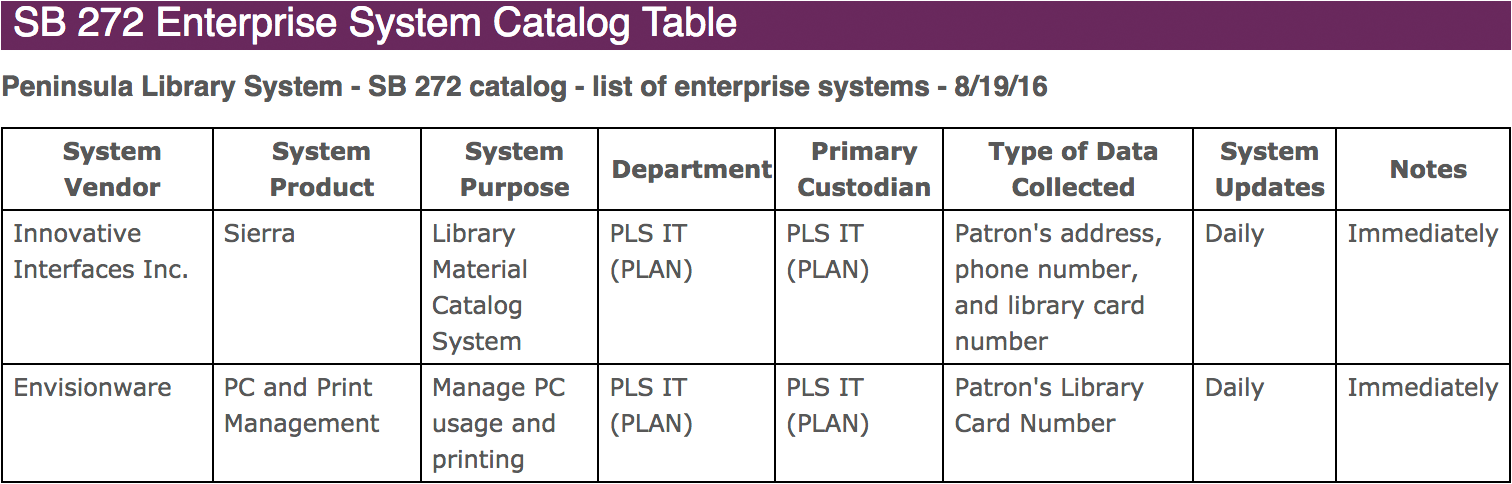
SB 272 Enterprise System Catalog
Senate Bill 272
Approved on October 11, 2015, adds a section to the California Public Records Act requiring local agencies to create a catalog of Enterprise Systems by July 1, 2016 with annual updates.
Enterprise System
A software application or computer system that collects, stores, exchanges and analyzes information that the agency uses that is both of the following:
- A multi-departmental system or a system that contains information collected about the public.
- A system that serves as an original source of data within an agency.
- An Enterprise System does not include any of the following:
- Information Technology security systems, including firewalls and other cybersecurity systems.
- Physical access control systems, employee identification management systems, video monitoring and other physical control systems.
- Infrastructure and mechanical control systems, including those that control or manage street lights, electrical, natural gas or water or sewer functions.
- Systems related to 911 dispatch and operation or emergency services.
- Systems that would be restricted from disclosure by Section 6254.19.
- The specific records that the information technology system collects, stores, exchanges or analyzes.
Requirements
- Create a catalog of enterprise systems, containing:
- Current system vendor
- Current system product
- System’s purpose
- A description of categories or types of data
- The department that is the prime custodian of the data
- The frequency that system data is collected
- The frequency that system data is updated
- To make the catalog publicly available upon request
- To post the catalog in a prominent location on the agency’s website
Exception
If the public interest served by not disclosing the information described clearly outweighs the public interest served by disclosure, the local agency may instead provide a system name, brief title or identifier of the system.
Enterprise System Catalog Table